Research
Divisions
Environmental Soil Science
|
The Division is entrusted
with the responsibility to create a database
on the extent of soil pollution due to indiscriminate
use of fertilizers, city, industrial and agricultural
wastes for crop production and to develop suitable
prescriptions and technologies for safe recycling
of these wastes into agriculturally productive
soils. The division is also engaged in evaluating
sink capacity of soils for heavy metal pollutants
and major environmental issues related to organic
farming.
The divisional laboratory is
equipped with the equipments like, Polarographic
analyzer, Water analyzer, Soxlet apparatus,
BOD and COD analyzer, Infra red gas analyzer
(IRGA), Water potential system, TLC, Ion chromatograph,
UV-visible spectrophotometer, N distillation
system, Flame photometer, Nephalometer besides
other basic facilities.
|
|
Read More.....
|
Soil Physics
|
The major focus of research of this division
is on enhancing/ sustaining soil quality, productivity
and input use efficiency through studies on
conservation tillage, interaction of water and
nutrient/ tillage, crop diversification, rain-water
harvesting and moisture conservation, simulation
models for water and nutrient transmission and
uptake, management of soil physical properties,
soil aggregation dynamics, soil organic carbon
conservation and sequestration in relation climate
change etc.
The divisional laboratory is equipped with
sophisticated equipments (pressure plate apparatus,
sand box, neutron moisture meter, depth density
gauge, Guelph permeameter, K-permeameter, rainfall
simulator, wet sieving apparatus, root scanner
and image analysis system, automatic runoff
recorder and sediment collection, automatic
weather station etc.)
|
Soil Biology
|
Division of Soil Biology
is entrusted with responsibility to undertake
research on maintaining soil biodiversity in
agro-ecosystem. Soil biochemical attributes
and produce quality indices, development of
technologies of recycling of various C: N ratio
wastes, assessment of soil quality parameters,
quality of organic pools, soil C/C sequestration
under different agro system, characterization
of functional communities of soil organisms
and microbial biodiversities have been taken
up as major programme of research.
Important equipments in this
divisional laboratory include HPLC, GLC, laminar
flow, BOD incubator, research microscope with
camera and CCTV system, automatic media distributor,
incubator shaker and other basic facilities
like muffle furnace, vacuum driver, water purification
system, Gerhardt block digester and inoculation
room.
|
Soil Chemistry and Fertility
|
The Division is poised
to play a key role in meeting out the challenges
enumerated in the vision 2050 of the institute,
especially, the challenges for ensuring food
and nutritional security from shrinking land
resources and achieving self reliance in crop
fertilization through indigenous mineral and
by-product sources. The Division will also be
playing a key role in generating wisdom, and
techniques for sustaining soil health and improving
nutrient use efficiency through precision agriculture,
nanotechnology and biotechnology. Besides, the
Division will continue to collaborate with scientists
from other divisions in meeting out the challenges
of characterizing and conserving large soil-biodiversity
for appropriate deployment in agriculture; developing
efficient technologies of waste recycling; maintaining
soil quality and ecological balance, and developing
energy efficient agriculture, carbon sequestration
etc..
|
|
Read More.....
|
PME Cell (Prioritisation, Monitoring and Evaluation
Cell)
PME Cell is undertaking the coordinated
compilation of following activities:
- To coordinate and synthesize the recommendations
of QRT, RAC, IRC, Vision documents of institute
and ICAR to recommend research priorities of the
institution for shortlisting priority researchable
problems across crop(s)/divisions/programmes, commodity/livestock
etc. at institution level. (Priority setting).
- Annual updating and presenting the report to
the Director of the institution for assigning research
projects.
- To coordinate and arrange for annual monitoring
of each ongoing projects and evaluation of completed
projects through internal and external experts.
- To coordinate and arrange for technology validation
and/or impact assessment of successful technology
claimed by scientist(s) through internal and external
experts.
- Regularity sensitizing and capacity building
of research managers and scientists through training
programmes.
- Maintaining a database on all publications,
technology development, IPRs, consultancies, projects
undertaken in the past 10 years and ongoing projects.
Manpower
| Sl. No. |
Name |
Present Designation |
Date of joining ICAR |
Email ID |
| 1 |
Dr. R. Elanchezhian |
Pr. Scientist & I/c PME Cell |
09-11-1998 |
elanchezhian.r[at]icar[dot]org[dot]in; pmecelliiss[at]gmail[dot]com |
| 2 |
Mr. Sanjay Kumar Kori |
Personal Assistant |
03.01.2012 |
sanjay.kori[at]icar[dot]org[dot]in |
Proforma to be submitted to PME Cell
by author(s) for forwarding
research manuscript for publication in research
journals
Proforma to be submitted to PME Cell
by author(s) for forwarding
abstract/full paper for presentation to the National/International
seminar/symposia/conference etc.
CR - I of IISS
CR - II of IISS
CS - I of IISS
CS - II of IISS
RPPs Annexures
Status Report & RPP-I of IISS
RPP-II of IISS
RPP-III of IISS
ICAR Amended Guidelines
ICAR-CSR Guidelines
ICAR-Research Data Management Policy
Operationalization of CSR ICAR Guidelines
Academic- Coordinator
The Academic Coordinator acts as the central point of planning, documentation, student administration and liaison for all academic activities conducted at the Institute. The function covers postgraduate (M.Sc./Ph.D.) research scholars registered with different universities, short-term trainings, and institute-level capacity development programmes. The key responsibilities include registration and university liaison, coursework & Credit Management, Examinations, evaluations, and institute fellowship / HRD Documentation.
AKMU, Remote Sensing and GIS Section
The Remote sensing and
GIS laboratory has been established to disseminate knowledge
of geospatial technologies in natural resource management
and to support advanced research and education in environmental
remote sensing, GIS, spatial analysis and modeling.
The laboratory is well equipped with work stations,
digitiser, plotter, ArcGIS, ERDAS Imagine and SPSS.
It provides state-of-art facility for GIS, image processing,
modelling, statistical analysis and visualisation.
Agricultural Knowledge Management Unit (AKMU)
Agricultural Knowledge
Management Unit (AKMU) is equipped with all modern facilities
to provide e-mail connectivity and browsing facility
through Internet to all the scientists and officials.
Local Area Network (LAN) Server has been connected to
Internet through our own VSAT. LAN is in operation with
75 nodes. AKMU is maintaining its own e-mail server
(iiss) using Linux (Red Hat 9.0). E-mail accounts of
all the scientists and officials have been created.
The AKMU is also engaged in creating database related
to soil nutrients. Home page and website for the Institute
have been launched.
Library, Information and Documentation services
The library
is well maintained with facilities lending,
reference service, reprographic services etc.
The Library also exchanges the institute publication
with the other ICAR Institutes, SAUs and renowned
Scientists in the field of Soil Science. The
institute library has been further strengthened
with following new additions.
|
Documents
|
Addition during
2015-16
|
Total
|
|
Books
|
Nil
|
|
2591
|
|
Bound Journals
|
Nil
|
|
2555
|
|
Annual Reports
|
99
|
|
2251
|
|
Foreign journals subscribed
|
3
|
|
3
|
|
Indian journals subscribed
|
19
|
|
19
|
The library
is well maintained with the facilities of Document
Lending Service, Reference service, Reprographic
Service. During this year, library has acquired
AGRIS database of FAO under the NATP scheme
in order to strengthen the library. The library
is already having SOIL-CD on the CD media and
is providing search facilities to users. The
databases of books, annual reports, and other
documents are being maintained on Window version
of CDS/ISIS, i.e., WINISIS. Current Awareness
Service (CAS) is also being provided to the
users by content page of the journal(s).
Infrastructure Development
Screen House
The institute has developed two
screen houses for providing facilities to conduct
pot experiments as per the requirement of different
research projects.
Conference Hall
The institute
has well furnished and air-conditioned conference
room with a sitting capacity of 120 persons.
It has an excellent conferencing facility consisting
of audio system with detachable cable mounted
microphones, audio-visual projection systems
with DLP technology based multimedia projector.
Stand by arrangements of slide projector and
overhead projector have also been made.
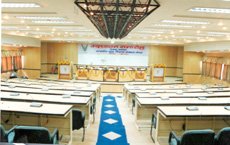
Conference
Hall
A well-furnished
and air conditioned committee room equipped
with audio system with detachable cable mounted
microphones, audio-visual projection systems
with multimedia projector, computer and stand
by arrangemnets of slide projector and overhead
projector has been developed to facilitate the
organisation of meeting, group discussions and
seminars. The committee room has total sitting
capacity for 65 persons.
Training/ Referral
Soil Testing Laboratory
The laboratory
has been established to develop new methods
or modify existing methods of soil and plant
analysis and to provide refresher training to
personnels of state/central/private organisations
involved in the analysis. It also provides facilities
for analytical quality check among the laboratories
through sample exchange. All the routine facilities
for soil and plant analysis including distillation
unit, spectrophotometer, flame photometer, precision
balance are available in the laboratory.
Other Facilities
In addition to the above facilities
the Institute also have facilities like Training
hostel, Staff Recreation club, Indoor/Out door
Games etc.
|
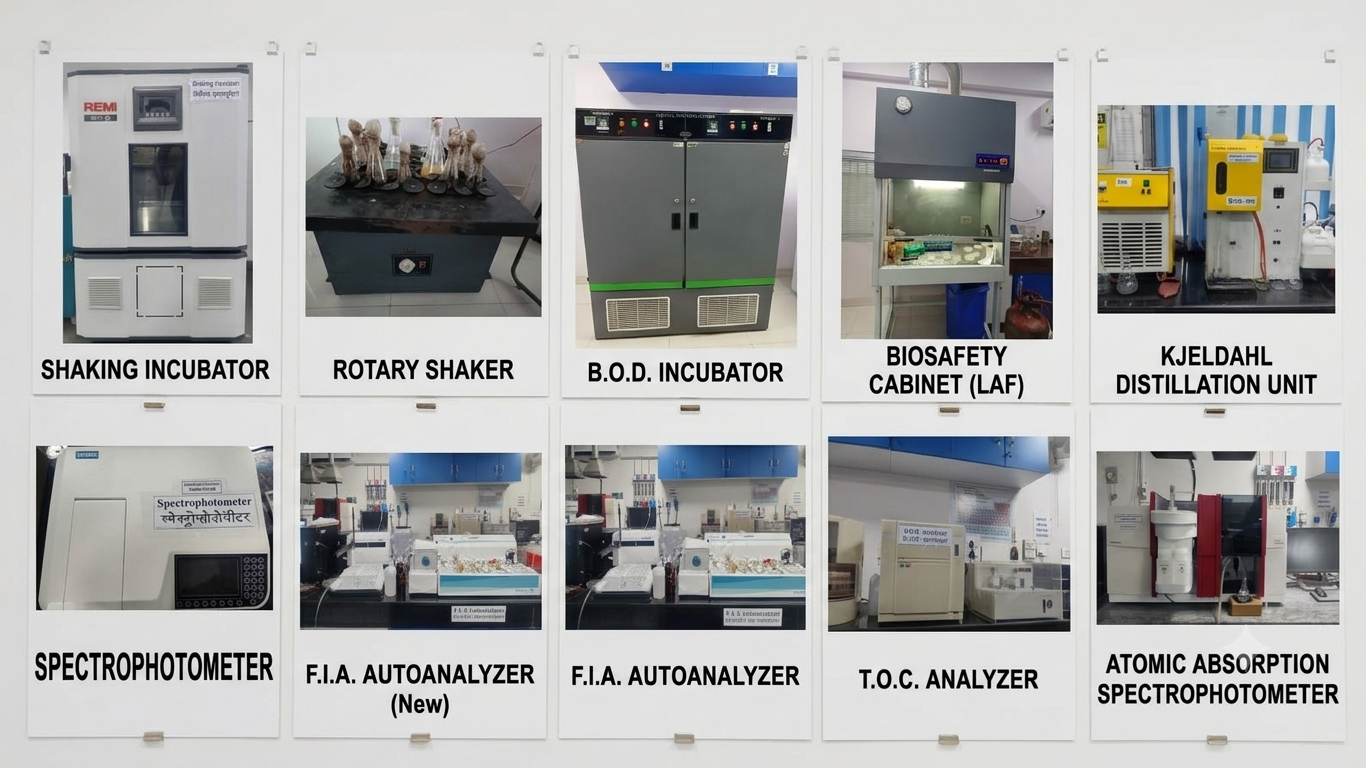
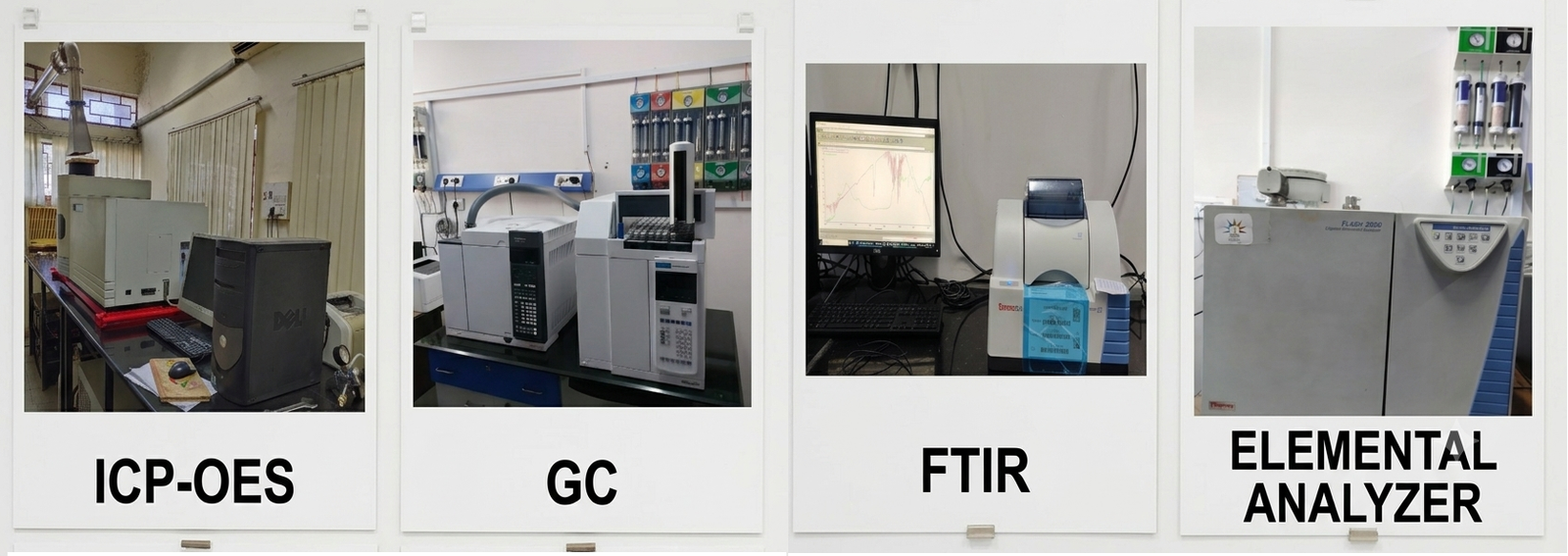
Central Instrumentation Facility of ICAR-IISS, Bhopal
The Central Instrumentation Facility (CIF) is established to provide access to sophisticated analytical instruments for research, teaching, and extension activities. The facility ensures efficient utilization, proper maintenance, and transparent operation of all equipment through standardized procedures. The lab offers soil testing, analysis and detection services to farmers, researchers and other stakeholders.
• SOP of CIF
• Equipment available and parameters analysed at ICAR-IISS, Bhopal
• Rate for soil testing services at ICAR-IISS, Bhopal
• NABL Certificate of ICAR-IISS, Bhopal
• Scope of Accreditation for testing parameters at ICAR-IISS, Bhopal
• SOP Manual for Equipment of CIF, ICAR-IISS, Bhopal
• Soil Analysis Rate List
|
|


